Star Island Villa Rental Pricing 2026: Why the Numbers Are What They Are
Pricing 8 min May 12, 2026
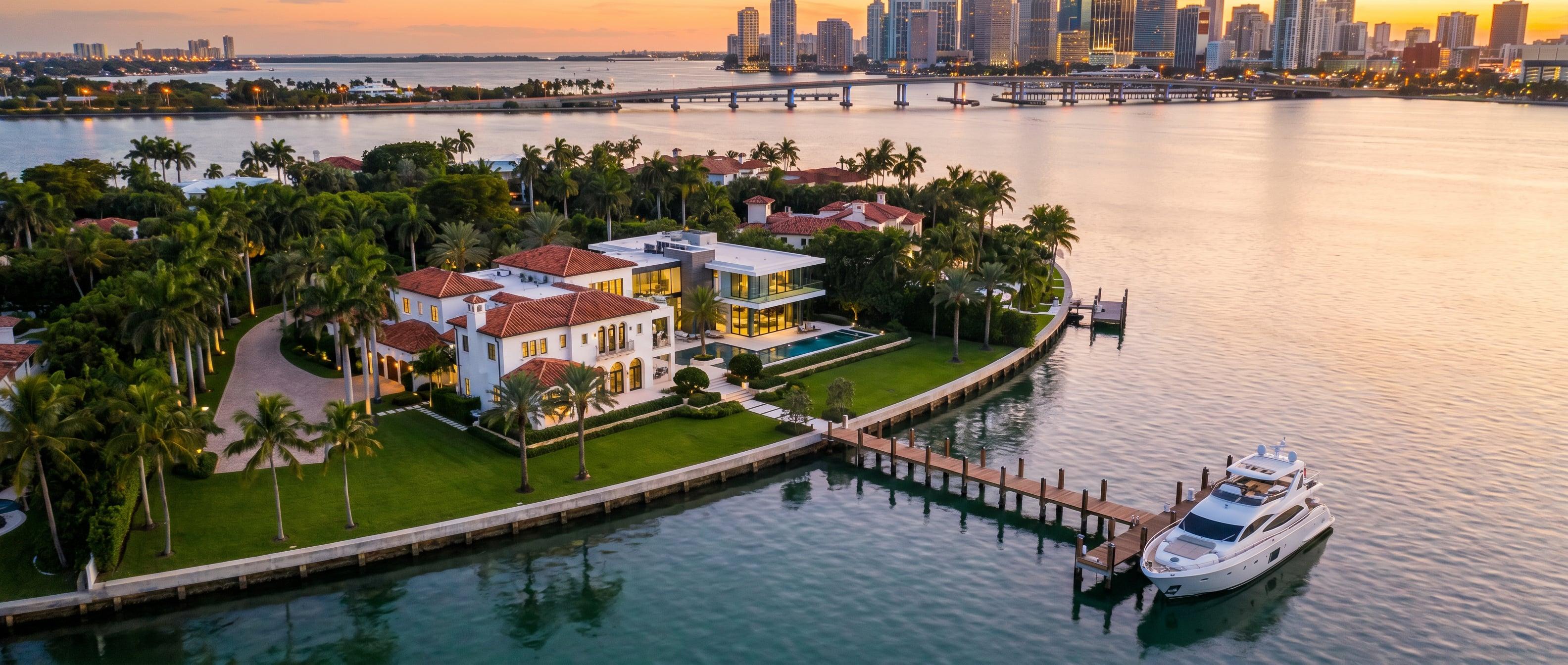
Star Island commands rental prices that sit at the top of the Miami market, with nightly rates running twelve thousand to fifty thousand and trophy compound estates pushing higher still. The numbers are not arbitrary luxury markups, and they are not easily defensible on a generic dollar-per-square-foot basis. They are the working price of a structural rarity: forty-something residential lots on a single dredged-fill island, gated causeway access, downtown Miami sightlines, and a hundred-year history that begins with Carl Fisher's dredges in 1917. This piece breaks down what actually drives the pricing on Star Island in 2026, with reference to specific sale comparables, the geography that the dredging created, and the structural supply constraint that anchors the rental market.
The 1917 origins behind a fixed supply
Star Island did not exist before 1917. Carl Fisher, the Indianapolis Motor Speedway founder who had recently moved to Miami Beach to develop the barrier island, financed the dredging of the bay floor to create three artificial islands. Palm, Hibiscus, and Star were built up from the Biscayne Bay floor in a single coordinated effort across 1917 and 1918. Star Island was platted with forty-something single-family lots arranged along a single curved street that loops around the island perimeter and returns to the gated causeway entry.
The forty-lot count is the structural supply constraint that defines the rental market a hundred years later. The island cannot be subdivided, cannot accommodate condominium development under the residential zoning, and cannot absorb new properties beyond the original platted inventory. A rental market built on forty lots, of which roughly half are owner-occupied and only a fraction enter the rental rotation in any given year, sits in structurally thin supply against a Miami demand profile that grows year over year. The pricing reflects this scarcity.
The geography that earned the sightlines
Star Island sits between the MacArthur Causeway and the South of Fifth district of Miami Beach, with the eastern lots facing downtown Miami across Biscayne Bay and the western lots facing the South Pointe Park headland. The downtown-facing eastern lots are the trophy positions; the skyline view across the bay is the angle that earns the price ceiling. Sunrise and the city-light pattern at night both deliver from these lots in a way that no inland Miami Beach property can replicate.
The lot orientation matters more on Star Island than on most other Miami properties. A western Star Island lot at the same nominal bedroom count and finish runs roughly seventy to eighty percent of the equivalent eastern lot's nightly rate, given the absent downtown view. Buyers shopping Star Island as a destination should anchor the property search on lot orientation as much as on bedroom count, because the view profile is what defines the experience.
Recent sale comparables and the rental rate that follows
Star Island residential sale comparables across 2023 through 2025 have consistently landed in the thirty to ninety million range for the standard six-to-twelve bedroom estate inventory, with the trophy compound estates that occupy multiple platted lots landing above one hundred million. A 2024 sale on the eastern downtown-facing strip closed in the high seventies for a nine bedroom estate on roughly an acre of waterfront. A 2023 compound sale that combined three lots into a single fourteen-plus bedroom estate closed above one hundred forty million.
The rental market follows the sale comparables on a roughly two-thousandths-of-sale-price-per-night working ratio across the standard estate inventory. A property that would sell at sixty million typically rents at eight to twelve thousand per night during the standard non-peak window, with the multiplier expanding during peak weeks. The ratio is not formula-driven and the actual rental rate runs against the specific property's finish, amenity profile, and rental management agreement. The ratio is a useful directional anchor for buyers calibrating expectations.
The structural costs that justify the rate
Star Island properties carry operating costs that inland Miami Beach properties do not. The maintenance load on a waterfront dredged-fill lot includes seawall reinforcement, dock pile inspection on a multi-year cycle, hurricane-grade window and door replacement schedules, and salt-exposure landscaping that requires replacement at roughly twice the cadence of inland properties. The annual operating spend on a Star Island estate, including property tax, insurance, and recurring maintenance, runs roughly two to four percent of the sale value, which is a multiple of the equivalent inland Miami Beach property.
The rental rate has to cover the operating cost amortization, the financing cost on the property, the rental management fees, and the property-level concierge and security staffing. Working backward from these structural costs, the nightly rate floor on a six bedroom Star Island property at the median sale comparable lands at roughly eight thousand to twelve thousand. That floor is what the rental market clears at outside of peak season. The peak-season multipliers stack on top of this floor rather than constituting the standard rate.
Forty platted lots on a single private island, and only a handful reach the rental market in any given year. That scarcity is what the pricing reflects.
LIMITLESS VILLAS · Star Island Desk
Peak season pricing on Star Island specifically
The Star Island peak season pattern runs hotter than the broader Miami market. Art Basel week in December commands a two-and-a-half-to-three-times multiplier on Star Island given the proximity to the Wynwood programming and the trophy-buyer demand. New Year week (December 26 through January 2) runs at two-to-two-and-a-half-times. F1 weekend in May, given the increased Miami trophy-event demand profile, runs at two-to-two-and-a-half-times on the strongest properties. Spring break weeks across March and April run at one-and-a-half-to-two-times.
The specific compound estates on Star Island, the ones at twelve to fourteen plus bedrooms, often book at peak rates a year in advance for the strongest weeks. The standard inventory rotation suggests that buyers shopping Star Island for a peak-window stay should be in conversation with the desk twelve to eighteen months before the dates. Off-peak window pricing (May through October excluding the F1 weekend) lands at roughly fifty to seventy percent of the peak rate, which is the access point for buyers testing the Star Island pattern.
Comparison against the parallel addresses
Star Island sits at the top of the Miami rental market, but it is not the only address at this tier. Indian Creek, the forty-residence Billionaire Bunker on the inland side of Bal Harbour, runs in parallel with Star Island on most pricing metrics, with a slightly higher floor given the smaller community size and the private police force. Fisher Island offers a meaningfully different access pattern (ferry-only, on-island Club lifestyle) at a lower entry tier; a four bedroom Fisher condominium starts at four to five thousand a night, against the Star Island floor of eight thousand and up.
Hibiscus Island and Palm Island, the two sister islands dredged in the same 1917 program, sit one tier down from Star on the standard pricing comparison. A comparable eight bedroom property on Hibiscus or Palm runs roughly seventy to eighty percent of the Star Island rate, given the absent downtown sightlines and the slightly less trophy-tier residential register. The Coral Gables Mediterranean Revival estates compete at the trophy ten-to-twelve bedroom tier with Star Island compound estates, with the architectural register as the differentiator rather than the waterfront and view profile.
Frequently asked
How much does a Star Island villa actually rent for in 2026?
Twelve thousand to fifty thousand per night across the standard six-to-twelve bedroom estate inventory. The lower end covers six bedroom properties on the western-facing lots without the downtown view. The mid-range covers eight-to-ten bedroom estates with mixed waterfront orientation. The upper end covers ten-to-twelve bedroom downtown-facing estates with deep-water dock access. Trophy compound estates above twelve bedrooms run from twenty-five thousand to fifty thousand and up, with peak-season multipliers pushing higher.
Why does Star Island cost what it does compared to the rest of Miami Beach?
Three reasons stacked. The supply is structurally limited to roughly forty residential lots that cannot be subdivided. The geography earned downtown Miami sightlines from the eastern lots that no inland Miami Beach property can replicate. The operating cost profile on a waterfront dredged-fill lot is meaningfully higher than the equivalent inland property given seawall and dock maintenance and salt-exposure landscape. The rental rate covers all three structural factors.
How far in advance do I need to book Star Island for peak weeks?
Twelve to eighteen months out for the strongest weeks (Art Basel, New Year, F1 weekend). The trophy compound estates often book for these windows a year before the dates. Off-peak windows (May through October excluding F1 weekend) can be booked at six to ten weeks lead time on most properties. The desk pre-books peak inventory in May and June of the prior year.
Are the eastern-facing lots actually worth the premium?
For most buyers, yes. The downtown Miami sightline is the angle that defines the Star Island experience, and the property lots without it deliver a different (smaller) value proposition. Buyers anchored on the trophy-island setting but not specifically on the view profile can extract good value from the western-facing properties at roughly seventy to eighty percent of the equivalent eastern rate. The desk surfaces both options when the buyer brief is ambiguous on the view requirement.
Inquire on Star Island availability
Send your dates, group size, and bedroom range. The Star Island desk surfaces matching estates within twenty-four hours.