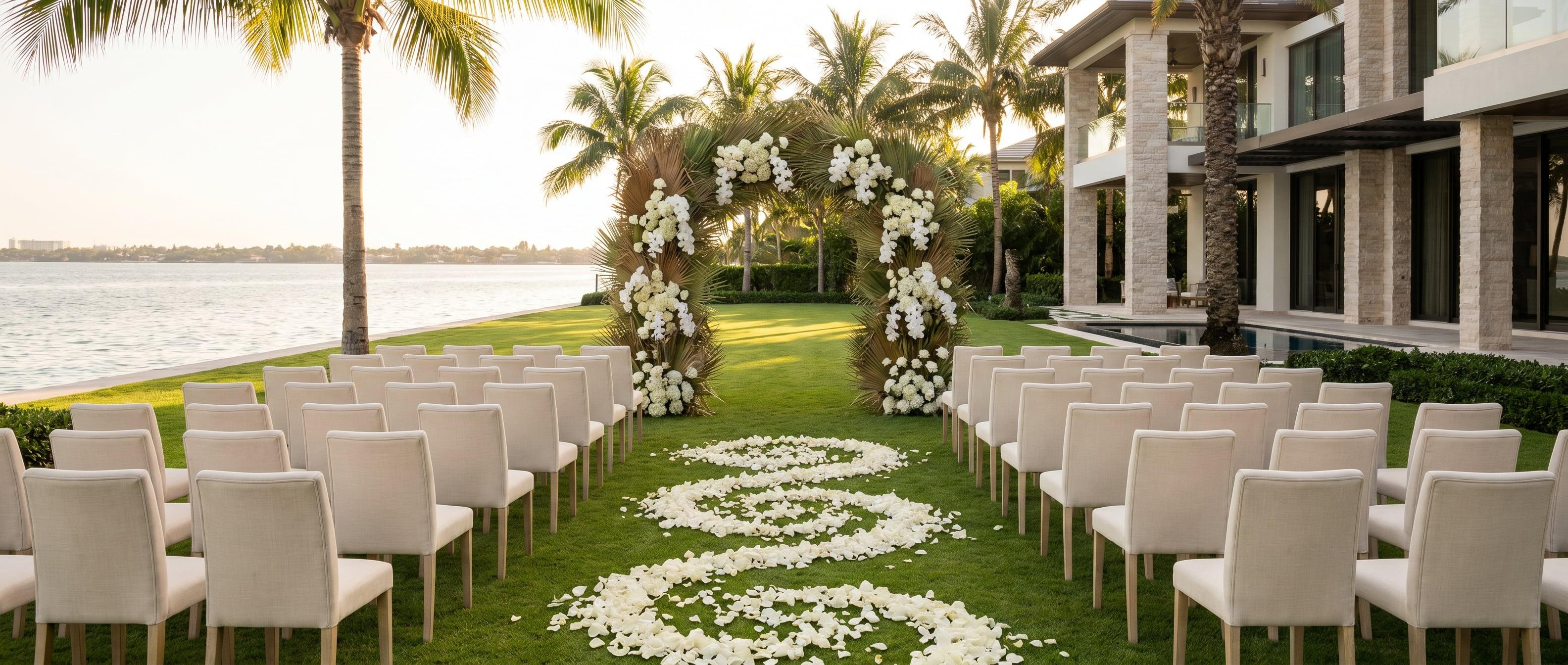
The Editorial Guide to a Miami Wedding Villa Rental
Editorial 11 min May 12, 2026
A Miami wedding villa rental is a different kind of booking than a vacation rental at the same property. The booking spans three to four days rather than one night, the property absorbs ceremony staging and vendor traffic rather than just lodging, the guest count on property runs five to ten times the standard rental occupancy, and the lead time on the strongest dates runs six to eighteen months out. This editorial guide walks through how to think about a Miami villa wedding from the planning stage forward, with notes on lead time, vendor coordination, ceremony-space requirements, guest accommodation, the noise ordinance, and the partner-venue handoff threshold. The pricing math is documented separately in /the-insider/wedding-villa-rental-cost-miami.
How to think about lead time
Miami wedding villa bookings need lead time that runs six to twelve months at the standard inventory tier and twelve to eighteen months for trophy estates on Star Island, Indian Creek, Coral Gables, and Hibiscus Island. The peak Miami wedding season runs October through May, with November and April carrying the highest demand. Couples planning a peak-season wedding should be in conversation with the desk eighteen months out and should expect property availability to compress dramatically as the date approaches.
Off-season July and August dates carry meaningful lead-time flexibility (two to three months works at most properties) and run thirty to forty percent below peak rates. The trade-off is the Miami summer weather profile (high heat, afternoon thunderstorms, higher hurricane-season risk) and the slower wedding-vendor calendar across those months. The desk runs the off-season pattern for couples whose priorities are budget compression and property selection rather than the peak-window aesthetic; the trade-off conversation happens at the inquiry stage.
For couples whose date is fixed (anniversary, family milestone), the lead time question reverses into a property-flexibility question. The desk surfaces what is actually available against the fixed date rather than requiring date adjustment.
Ceremony space planning
The standard wedding villa ceremony pattern uses the pool deck or the lawn for the ceremony seating, the terrace for the cocktail hour, and the great room or under-tented outdoor staging for the dinner reception. For sixty-guest weddings, most six-bedroom properties accommodate the pattern on standard grounds. For one-hundred-guest weddings, eight-bedroom properties carry the grounds scale that supports the pattern. For one-hundred-fifty guest weddings, the pattern starts to strain standard inventory and the partner-venue handoff becomes the working pattern.
The ceremony-space question typically gets surfaced at the property-fact-sheet stage. The fact sheet documents the usable ceremony area in square footage, the lawn or pool-deck orientation against the typical Miami sun pattern at the wedding date and time, the indoor backup space for weather contingency, and the vendor staging areas (kitchen prep, florist install, music load-in). The concierge desk produces a working venue layout in collaboration with the day-of coordinator at the contract stage.
For outdoor ceremonies, the weather contingency planning is non-negotiable. Miami afternoon thunderstorms can collapse a four PM outdoor ceremony with thirty minutes of warning during the May-through-October season. The standard pattern is a tented backup configuration that pre-stages without committing.
Vendor coordination, walked through
The standard Miami wedding vendor stack covers seven categories: planning and day-of coordination, catering, florals, music (live band or DJ), photography and videography, rentals (chairs, tables, linens, lighting, tented staging), and security and parking management. Each category runs on a separate vendor relationship that the planner coordinates rather than the property concierge.
The LIMITLESS VILLAS concierge desk maintains a vetted vendor list across all seven categories, with three to five preferred relationships per category that the desk has worked with on prior bookings. Couples can work the vetted list or bring their own vendors against the property fact sheet. The desk does not charge a coordination fee on the vendor side; the planner-vendor relationships are direct.
The vendor-staging logistics are the desk's responsibility, not the planner's. The desk coordinates the load-in path, the staging window (typically the wedding party gets the property Friday morning for a Saturday evening ceremony), the kitchen release to the catering vendor, the security-and-parking management at gated-island properties, and the post-event property reset. The clean handoff between planner-side vendor coordination and concierge-side property staging is what determines whether the wedding actually runs smoothly.
The guest accommodation question
Wedding villa bookings carry the wedding party on property for the rental window. The standard rooming pattern at a six-bedroom property accommodates twelve to fourteen wedding-party guests (the couple, immediate family, the wedding party); at an eight-bedroom property, sixteen to twenty; at a ten-bedroom milestone-event estate, twenty-two to twenty-six. Additional wedding guests beyond the wedding-party rooming require separate accommodation.
The concierge desk coordinates the guest accommodation across three patterns. The first is a hotel block at a nearby property (Miami Beach hotels for the central neighborhood weddings, Coral Gables hotels for the Coral Gables weddings) with the desk negotiating a group rate against the wedding window. The second is a secondary villa rental at an adjacent property; for trophy weddings, the desk often blocks two or three adjacent properties to absorb extended-family guests with the same property quality as the wedding-party residence. The third is an Airbnb-style overflow for younger guests who want a separate base.
The accommodation logistics get surfaced at the eight-week pre-event mark when the guest manifest is firm. The desk maintains relationships with the standard Miami hotel partners to negotiate the group rate; for couples without prior hotel-block experience, the desk runs the negotiation as part of the concierge service density.
A villa wedding is a four-day rental, a multi-vendor coordination, and a property-as-venue commitment. The planning depth scales with all three.
LIMITLESS VILLAS · Wedding Desk
The noise ordinance and music logistics
Miami's residential noise ordinance varies by jurisdiction. The City of Miami Beach ordinance permits amplified outdoor music until eleven PM on Friday and Saturday and until ten PM on other nights. The City of Miami (Brickell, Coconut Grove, and the surrounding mainland) runs a stricter eleven PM cutoff across all nights. Coral Gables runs a stricter ten PM cutoff with property-specific HOA further compressing the window on some streets. The private islands (Star, Hibiscus, Palm) follow the Miami Beach ordinance but with additional property-level expectations around evening quiet.
The wedding-music timeline is planned against the property-specific ordinance from the contract stage. The standard pattern for a Miami Beach property is ceremony at four PM, cocktail hour at five, dinner reception six to nine, dance floor nine to eleven with the cutoff at eleven sharp. For Coral Gables properties, the dance floor compresses to nine to ten or the music shifts indoors at the cutoff. Indoor amplified music typically runs later than the outdoor cutoff but is sized for a smaller capacity.
For wedding events that need a later dance-floor window, the partner-venue handoff to a hotel ballroom (Faena Forum, the Biltmore, the Loews Miami Beach) is the standard pattern. The wedding-party stays on the villa; the after-ten-PM portion of the reception moves to the partner venue.
When to use a partner venue rather than the property
The villa-only wedding pattern works decisively up to one hundred guests on property at the right villa. Between one hundred and one hundred fifty guests, the villa-only pattern still works at trophy estates with the grounds scale to absorb the larger ceremony and reception, but starts to strain standard inventory. Above one hundred fifty guests, the partner-venue handoff is the working pattern: the villa hosts the wedding party for the multi-day rental window, and a partner venue (the Biltmore in Coral Gables, Vizcaya Museum and Gardens in Coconut Grove, the Faena Forum in Miami Beach, Indian Creek Country Club) hosts the formal ceremony and reception.
The partner-venue pattern adds twenty to fifty thousand to the wedding budget compared to the villa-only pattern, given the venue rental fee and the separate venue catering minimums. The math works for weddings above one hundred fifty guests where the alternative is a trophy compound estate at fifty thousand per night or higher.
For weddings on Star Island, Indian Creek, and the Coral Gables Mediterranean Revival estates, the on-property pattern often works up to one hundred fifty guests given the estate grounds scale. The concierge desk runs both patterns in the proposal so the couple can compare. The decision is rarely binary; the partner-venue handoff is often the right call for the formal ceremony with the villa absorbing everything else.
Photography logistics, walked through
Miami villa weddings carry strong photographic potential that the photographer should be briefed on at the contract stage. The standard shot list for a villa wedding covers the wedding-party prep in the bedroom suites, the ceremony itself, the cocktail hour on the terrace, the dinner reception in the great room, the dance floor, and the property exterior for the formal portrait session. For dock-front and oceanfront properties, the property exterior shots typically anchor on the water and the sunset orientation.
The golden-hour timing in Miami runs roughly forty-five minutes before sunset and is the working window for the formal portrait session. The October-through-April peak wedding season sees sunset between five-thirty and seven-fifteen PM. A November wedding with a four-PM ceremony typically lands the formal portrait window between five and five-forty-five PM, which the photographer plans against at the contract stage.
The LIMITLESS VILLAS concierge desk handles photographer coordination as a service add-on through /concierge/photographer-coordination for couples without a preferred photographer relationship. For couples bringing their own photographer, the desk handles the location-release paperwork at the property level and confirms any property-specific photography constraints (drone restrictions on the gated islands, neighbor-courtesy considerations on the residential streets).
Frequently asked
How far in advance should we book the villa for a Miami wedding?
Six to twelve months for standard inventory on the strongest October-to-May weekend dates. Twelve to eighteen months for trophy estates on Star Island, Indian Creek, Coral Gables, and Hibiscus Island. Off-season July and August dates can sometimes be locked in eight to twelve weeks out at meaningfully lower rates.
Can we host the ceremony and reception on the same property?
Yes for weddings up to one hundred guests at most six-to-eight bedroom properties. For weddings between one hundred and one hundred fifty guests, trophy estates with the grounds scale absorb the pattern. For weddings above one hundred fifty guests, the partner-venue handoff is the standard pattern: villa for the wedding party plus venue (Biltmore, Vizcaya, Faena Forum, Indian Creek Country Club) for the formal ceremony and reception.
How does the noise ordinance actually affect the music timeline?
Miami Beach permits amplified outdoor music until eleven PM Friday and Saturday, ten PM other nights. Coral Gables runs a stricter ten PM cutoff across all nights. The City of Miami runs an eleven PM cutoff. The wedding-music timeline is planned against the property-specific ordinance from the contract stage; for events that need a later dance-floor window, the partner-venue handoff is the standard pattern.
Where do guests beyond the wedding party stay?
Three patterns. Hotel block at a nearby property with a negotiated group rate, secondary villa rental at an adjacent property for trophy weddings, or Airbnb-style overflow for younger guests. The concierge desk coordinates all three patterns and surfaces the right structure at the eight-week pre-event mark when the guest manifest is firm.
Does the desk handle the wedding planning or just the property?
The desk handles the property-side logistics (vendor staging, security and parking, the kitchen release, the property fact sheet, the day-of property support). A separate wedding planner is the right hire for the planning itself (vendor selection, day-of coordination at the event level, rehearsal dinner and brunch logistics, guest accommodation for non-wedding-party attendees). The desk maintains a short list of preferred Miami planners and recommends one or two depending on the wedding profile.
Start the wedding villa conversation
Send your wedding dates, guest count, and ceremony scope. The desk surfaces matching properties and walks through the planning timeline within twenty-four hours.